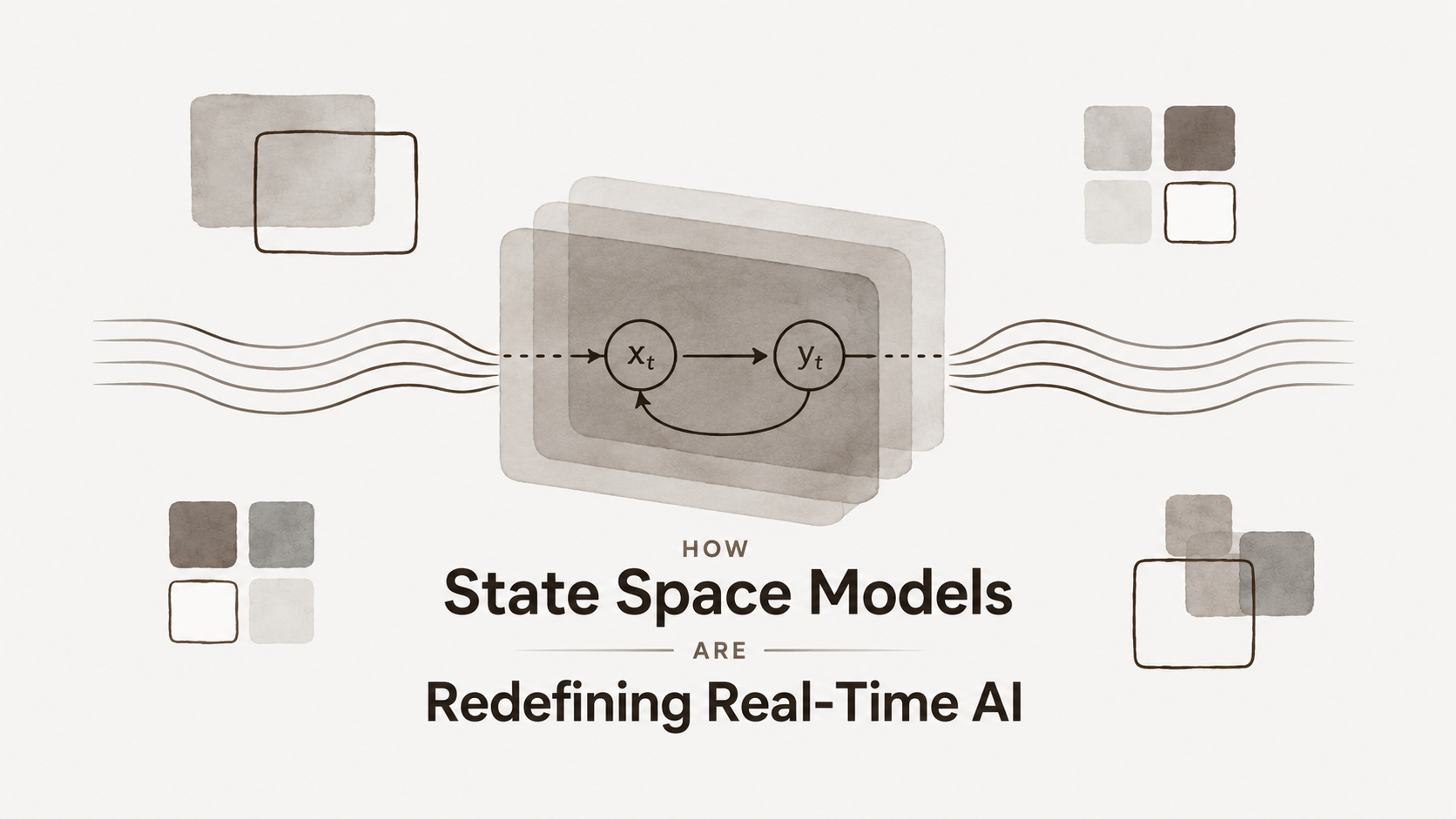
Transformers have dominated AI research for years, but they have a fundamental limitation: quadratic attention complexity makes real-time, long-context inference expensive.
At Crystal AI, we've bet on State Space Models (SSMs) as the architecture for real-time intelligence. Here's why.
The Latency Problem
Traditional transformer-based TTS models process the entire input sequence before generating any output. This means:
- Time-to-first-byte scales with input length
- Memory usage grows quadratically
- Streaming requires complex chunking heuristics
SSMs, by contrast, maintain a fixed-size hidden state that evolves over time. This enables:
- Constant-time step generation
- Linear memory scaling
- Native streaming without quality loss
Our Approach
We've developed a hybrid SSM architecture that combines:
- Selective state spaces for content modeling
- Cross-attention layers for voice conditioning
- Diffusion decoders for waveform synthesis
The result is a model that generates natural-sounding speech at 50ms latency while maintaining coherence over long passages.
Benchmarks
We evaluated our approach on standard TTS benchmarks:
- LJSpeech: 4.6 MOS (state-of-the-art)
- LibriTTS: 4.4 MOS with zero-shot cloning
- Real-time factor: 0.02x (50x faster than real-time)
Implications for Voice Agents
The low-latency characteristics of SSMs make them ideal for conversational AI:
- Agents can respond in under 100ms (including network overhead)
- Interruption handling feels natural to users
- Multi-turn conversations maintain context without recomputation
Our full research paper on this architecture will be published at ICML 2026. Preprint available on arXiv.
Conclusion
State Space Models aren't just an incremental improvement — they're a paradigm shift for real-time AI applications. At Crystal AI, we're committed to pushing the boundaries of what's possible with this architecture.